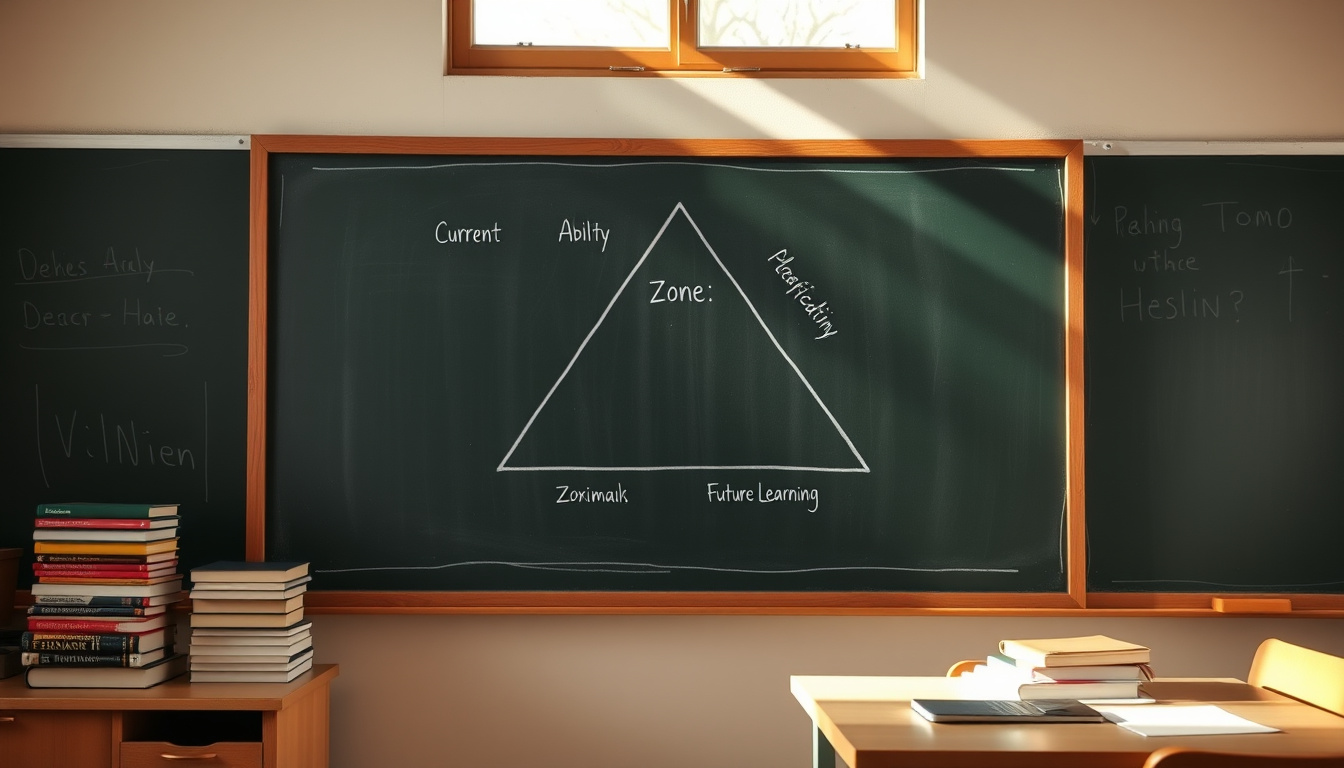
Every teacher has seen it happen: a student gets stuck on a problem they seem close to solving, then a well-timed hint from a peer unlocks the next step — that sweet spot between frustrated confusion and comfortable independence is exactly what Soviet psychologist Lev Vygotsky called the zone of proximal development (ZPD). This guide unpacks the four principles of Vygotsky’s theory, explains how scaffolding works in real classrooms, and shows teachers how to apply these ideas today.
Originator: Lev Vygotsky ·
Year introduced: 1978 (posthumous translation) ·
Core concept: Gap between independent and assisted performance ·
Related technique: Scaffolding ·
Key principle: Social interaction drives learning ·
Common application: Education
Quick snapshot
- ZPD defined as gap between independent and assisted performance (Simply Psychology (educational psychology resource))
- Scaffolding is temporary support that fades as learner gains independence (Study.com (education publisher))
- Concept introduced by Vygotsky in 1978 (Structural Learning (education resource))
- The exact measurement of ZPD remains debated
- Whether ZPD applies equally to all domains of learning
- 1978: Vygotsky’s “Mind in Society” published posthumously, introducing ZPD (Structural Learning (education resource))
- 1976: Wood, Bruner, and Ross coin “scaffolding” (Simply Psychology (educational psychology resource))
- ZPD increasingly applied in adult learning and professional development
- Digital tools and AI tutors offer new scaffolding possibilities
Five key facts define the zone of proximal development as a teaching framework.
| Attribute | Detail |
|---|---|
| Originator | Lev Vygotsky |
| Year | 1978 (posthumous publication of “Mind in Society”) |
| Core Idea | Learning occurs in the gap between what a learner can do alone and with help |
| Related Term | Scaffolding (Wood, Bruner & Ross, 1976) |
| Application | Education, cognitive development, instructional design |
The pattern: ZPD is a theory about where learning happens; scaffolding is the practical tool that gets learners there.
What are the 4 principles of Vygotsky’s theory?
What is the principle of social interaction?
- Vygotsky argued that cognitive development originates in social interaction before being internalized by the individual (Simply Psychology (educational psychology resource)).
- Learning first occurs at the social level (between people) and then at the individual level (inside the child’s mind).
- The implication: a child’s potential for learning depends heavily on the quality of social guidance they receive.
A student left alone with a difficult text may give up. A student discussing that same text with a partner or teacher has a path forward — not because the task changed, but because the social context did.
What is the principle of the more knowledgeable other?
- The more knowledgeable other (MKO) is anyone who has a higher understanding of a task or concept than the learner (PrepScholar (education resource)).
- An MKO can be a teacher, a peer, a parent, or even a digital tool like an AI tutor.
- The MKO guides the learner through the ZPD by providing tailored support.
- Peer-to-peer MKOs are especially effective: students just slightly ahead of their classmates can explain concepts in accessible language.
What is the principle of the zone of proximal development?
- The ZPD is the space between what a learner can do independently and what they can achieve with guidance (Edutopia (teacher resource)).
- Tasks that fall within the ZPD are challenging but achievable with help.
- Tasks below the ZPD are too easy and cause boredom; tasks above it cause frustration.
- The ZPD targets skills that are on the cusp of mastery (University of San Diego (education program)).
Identifying a student’s ZPD requires observation and assessment — it’s not a fixed zone but shifts as the learner grows.
What is the principle of scaffolding?
- Scaffolding is the temporary support that an MKO provides to help a learner complete a task in their ZPD (Simply Psychology (educational psychology resource)).
- Scaffolding techniques include modeling, questioning, breaking tasks into steps, and using prompts (Study.com (education publisher)).
- The support is gradually withdrawn — a process called “fading” — as the learner becomes more competent (Study.com (education publisher)).
What is the difference between ZPD and scaffolding?
How are ZPD and scaffolding defined?
ZPD and scaffolding are often mentioned together but they are not the same thing. ZPD is the learning space; scaffolding is the instructional technique used inside that space (Structural Learning (education resource)).
What is the relationship between ZPD and scaffolding?
Scaffolding is a dynamic process that adjusts as the learner gains independence (Study.com (education publisher)). The relationship is simple: ZPD is the “where” and the “why”; scaffolding is the “how.” A teacher identifies a student’s ZPD and then applies scaffolding to help them cross it.
Can scaffolding exist without ZPD?
The ZPD concept was introduced by Vygotsky; scaffolding was later developed by Wood, Bruner, and Ross in 1976 (Simply Psychology (educational psychology resource)). In practice, scaffolding is most effective when it is grounded in ZPD theory — but some teachers use scaffolding strategies intuitively without explicitly naming the zone.
The key contrast: ZPD is a theory about where learning occurs. Scaffolding is a technique for making that learning happen.
| Feature | ZPD | Scaffolding |
|---|---|---|
| Definition | Gap between independent and assisted performance | Temporary support provided within that gap |
| Origin | Vygotsky (1978) | Wood, Bruner, and Ross (1976) |
| Nature | Theoretical concept | Instructional technique |
| Role | Identifies where learning can happen | Makes that learning possible |
| Duration | Always exists (for any challenging task) | Fades as learner gains competence |
Three differences, one pattern: ZPD is the map; scaffolding is the guide that walks the learner across it.
How do teachers use the zone of proximal development?
How to identify a student’s ZPD
- Use pretests to gauge current independent performance (Indeed (career and education advice)).
- Observe students as they attempt tasks with and without assistance.
- Conduct dynamic assessment — a process where the teacher provides progressive hints and measures how much support is needed for success (Simply Psychology (educational psychology resource)).
- Formative assessment helps pinpoint where scaffolding should be targeted (Study.com (education publisher)).
Scaffolding techniques teachers can use
- Modeling: demonstrate the skill while thinking aloud.
- Questioning: ask guiding questions that push thinking forward.
- Breaking tasks into smaller, manageable chunks (Edutopia (teacher resource)).
- Providing clues, previewing vocabulary, and using visual supports (Study.com (education publisher)).
- Think-Pair-Share (TPS): a structured scaffolding technique with step-by-step guidelines (New York State Education Department (state education authority)).
Teachers who scaffold effectively match support to the specific gap a student shows — not all gaps are the same size or shape.
How to adjust instruction based on ZPD progress
- Gradually withdraw support as the student shows competence (Study.com (education publisher)).
- Introduce small increments of challenge to keep the learner in their ZPD.
- Encourage group work and peer support within ZPD (PrepScholar (education resource)).
- Use differentiation alongside scaffolding: adjust the support while keeping the task consistent (Structural Learning (education resource)).
The pattern: ZPD-informed teaching is not one-size-fits-all. It demands ongoing calibration between task difficulty and learner readiness.
What is Vygotsky’s scaffolding theory?
Who developed the concept of scaffolding?
Scaffolding was introduced by Wood, Bruner, and Ross in 1976, building on Vygotsky’s ideas about the ZPD (Simply Psychology (educational psychology resource)). Vygotsky himself did not use the term “scaffolding” — that extension came later from these researchers.
How does scaffolding relate to the ZPD?
Scaffolding provides temporary support to help learners achieve tasks in their ZPD (Simply Psychology (educational psychology resource)). The scaffold — whether a hint, a prompt, or a visual aid — bridges the gap between what the learner can do alone and what they can do with help.
What are examples of scaffolding in education?
- A teacher breaks a multi-step math problem into smaller sub-problems and guides the student through each one.
- During a reading lesson, the teacher pre-teaches vocabulary and then models the first paragraph while thinking aloud.
- Students use a graphic organizer to structure their writing before producing a full essay.
- A peer coach asks guiding questions as a classmate works through a science experiment setup.
Effective scaffolding shares three features: it is contingent on the learner’s current level, it fades as competence increases, and it transfers responsibility from the MKO to the learner (Structural Learning (education resource)).
What is a good example of zone of proximal development?
Example 1: Learning to read with a teacher
A first-grade student can decode single words but struggles with full sentences. The teacher reads the first sentence aloud, pointing to each word as she reads, then asks the student to read the next sentence together. Over several lessons, the student reads more sentences independently. The teacher’s shared reading is the scaffold; the ZPD is the distance between reading words alone and reading paragraphs alone.
Example 2: Solving math problems with peer assistance
A student can add two-digit numbers but gets stuck on three-digit addition with regrouping. A classmate who has just mastered this skill (acting as MKO) works through one problem together, explaining each regrouping step. The struggling student then tries the next problem with occasional prompts. The ZPD is the gap between adding two-digit numbers and adding three-digit numbers with regrouping; the peer’s explanation is the scaffold.
Example 3: Using prompts in language learning
An English language learner knows basic vocabulary but cannot produce full sentences about a picture. The teacher provides a sentence frame: “I see a ___ and a ___.” The student fills in the blanks. Over time, the frame is removed and the student constructs original sentences. The ZPD is the gap between single-word responses and full-sentence descriptions; the sentence frame is the scaffold (New York State Education Department (state education authority)).
Every ZPD example shares a core structure: a learner, a task that is one step beyond their current ability, and a guide who provides just enough support to bridge that gap.
The implication: ZPD is not a single moment but a recurring cycle — as the learner masters one level, a new zone opens beyond it.
Quotes from Vygotsky on the zone of proximal development
“The zone of proximal development defines those functions that have not yet matured but are in the process of maturing, functions that will mature tomorrow but are currently in an embryonic state.”
— Lev Vygotsky, Mind in Society (1978) (Simply Psychology (educational psychology resource))
“Scaffolding is a process that enables a child or novice to solve a problem, carry out a task, or achieve a goal which would be beyond his unassisted efforts.”
— Wood, Bruner, and Ross, 1976 (Simply Psychology (educational psychology resource))
These words capture the core of Vygotsky’s insight: learning is not about what students already know, but about what they are on the verge of knowing with the right support. For teachers, the ZPD is not a fixed measure — it is a potential space that shifts as the learner grows. The challenge is not just to find the zone, but to stay in it as it moves.
Frequently asked questions
What does ZPD stand for?
ZPD stands for Zone of Proximal Development, a concept introduced by Lev Vygotsky. It describes the gap between what a learner can do independently and what they can achieve with guidance from a more knowledgeable other (Simply Psychology (educational psychology resource)).
How is ZPD measured?
ZPD is not measured with a single test. Teachers typically use dynamic assessment — a process where they observe how much support a learner needs to complete a task — to identify the zone (Simply Psychology (educational psychology resource)). Pretests, observation, and formative assessments help calibrate where scaffolding should begin.
Can ZPD apply to adults?
Yes. ZPD applies to learners of all ages. An adult learning a new software tool, for example, might follow step-by-step tutorials (scaffolding) before using the tool independently. The same gap between guided and independent performance exists for adults as for children.
What is the difference between ZPD and Piaget’s stages?
Piaget argued that cognitive development unfolds in fixed, universal stages driven by the child’s independent exploration. Vygotsky’s ZPD theory holds that development is driven by social interaction and can be accelerated with the right guidance — it is not bound to rigid stages (Simply Psychology (educational psychology resource)).
How does ZPD relate to differentiated instruction?
Differentiated instruction adjusts the task, content, or assessment to fit each student’s readiness level. ZPD provides the theoretical rationale: the best learning happens when the task is challenging but achievable with support — which is exactly what differentiation aims to provide (Structural Learning (education resource)).
What are common misconceptions about ZPD?
One common misconception is that ZPD is a fixed space. In reality, the zone shifts as the learner gains competence. Another is that only teachers can be MKOs — peers, digital tools, and even books can serve the same role. A third is that scaffolding means doing the work for the student; it means providing targeted support that gradually fades.
Is scaffolding Vygotsky or Piaget?
Scaffolding is based on Vygotsky’s work, but the term was coined by Wood, Bruner, and Ross in 1976. Piaget’s theory does not include scaffolding, as it emphasizes independent discovery over guided learning (Simply Psychology (educational psychology resource)).
What are the stages of the zone of proximal development?
ZPD is not a multi-stage process in the way Piaget’s stages are. However, the learning process within ZPD typically follows this arc: 1) the learner cannot perform the task independently, 2) the MKO provides scaffolding, 3) the learner performs with support, 4) the scaffold fades, and 5) the learner performs independently. The cycle repeats for the next challenging task (Simply Psychology (educational psychology resource)).
For teachers aiming to apply ZPD principles, the choice is clear: stop asking what each student can do alone, and start asking what each student can do with the right support — then provide exactly that.
Related reading:

Priya Mitchell leads fact-checking, source verification and corrections at Oz Monitorly.