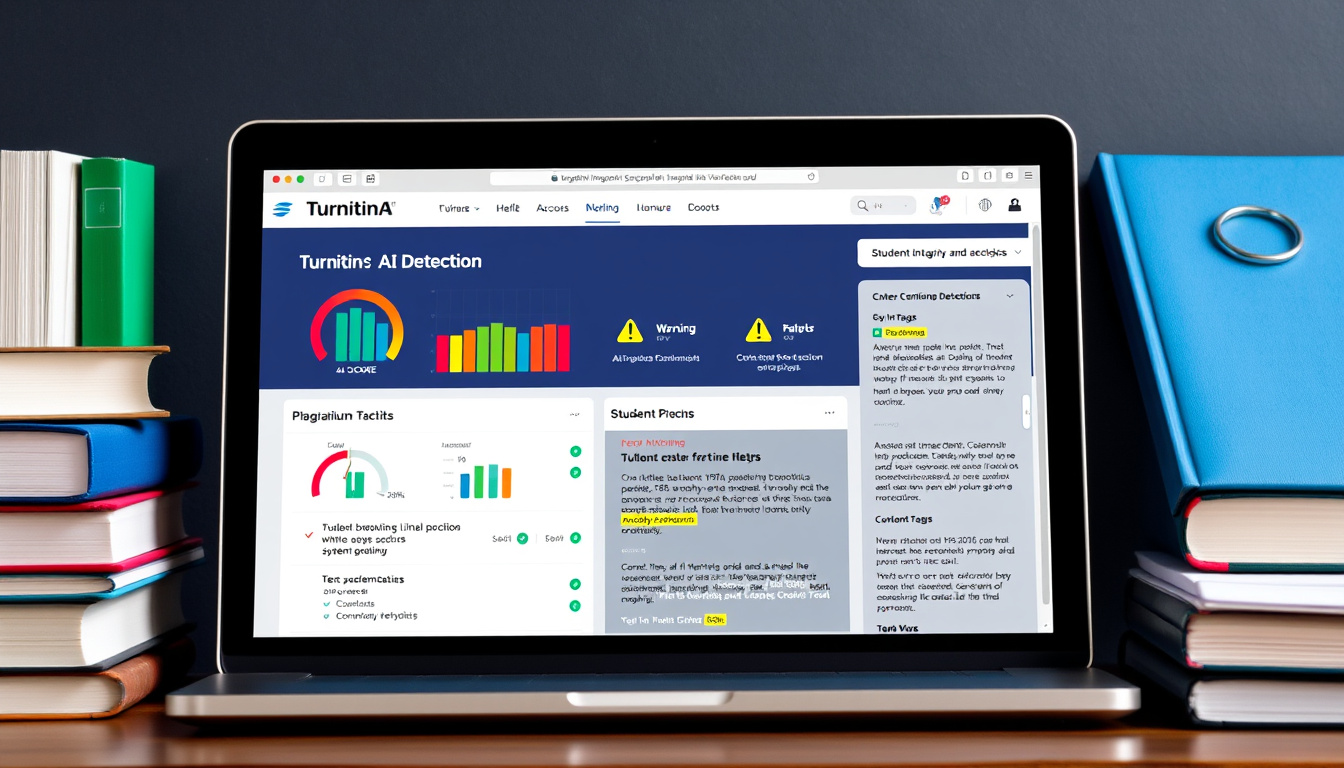
Turnitin’s AI detector flags roughly 1 in 9 student papers for potential AI authorship, according to an analysis of 200 million submissions. For students who have never encountered the system, the color-coded reports, probability scores, and institutional policies can feel deliberately opaque. Here is what the data shows about how well the detector actually works, where it fails, and what your score actually means.
Free Detector Available: Unlimited words, no signup · Official AI Checker: Detects ChatGPT and more · Similarity Reports: Interpreted by educators · AI Writing Detection: Designed for academic integrity · Student Checker Tools: Multiple online options
Quick snapshot
- Turnitin detects generative AI like ChatGPT (Times Higher Education)
- 98% accuracy on fully AI documents (RealProfessors)
- False positive rate below 1% for human text (Times Higher Education)
- Turnitin launched AI detection in April 2023 (PureWrite)
- 2024 study shows 96.4% accuracy on 500 papers (RealProfessors)
- Ongoing model updates to catch evolving AI tools (PureWrite)
- Detection accuracy continues improving with each AI model release
- Institutional policies on AI scores are still being developed
- Students should focus on original voice to avoid flagging
The table below summarizes the key specifications and capabilities of Turnitin’s AI detection system based on official documentation and independent analysis.
| Label | Value |
|---|---|
| Primary Use | Academic integrity checking |
| Free Access | Unlimited words on turnitin.app |
| Official Site | turnitin.com/solutions/topics/ai-writing |
| Guides Available | Turnitin Guides AI writing report documentation |
| Launch Date | April 2023 |
| Claimed Accuracy | 98% |
| False Positive Rate | Less than 1% |
| AI Threshold | 20% or higher flagged |
| Papers Analyzed | 200 million |
Can you see AI detection on Turnitin?
Yes, but with important nuances depending on your role in the academic process. Turnitin’s AI Writing Report is a separate indicator from the similarity score that many students are already familiar with.
How Turnitin displays AI detection
The AI Writing Report shows two distinct percentages: one for AI-generated text and another for AI-paraphrased content. According to Turnitin’s official documentation, the report displays an overall percentage alongside interactive category breakdowns that instructors can explore sentence by sentence. The system color-codes flagged passages — cyan highlights indicate AI-generated text while purple marks AI-paraphrased sections. Scores above 20% typically trigger a blue indicator, while lower percentages appear with an asterisk (*). This color system, sometimes called the Star AI Report, gives educators a visual map of where AI patterns appear in a document.
Accessing the AI writing report
For educators, the AI Writing Report becomes available automatically when submissions are processed through institutional accounts. Students typically access this information through their similarity report interface, though the level of detail visible to students varies by institution. Research from Turnitin’s official documentation confirms that the AI report runs alongside the traditional similarity check, giving instructors both pieces of information in a single view.
Students can see their overall AI probability score but may not access the granular sentence-level breakdown that instructors see. If your score seems high, ask your instructor specifically what the report shows.
Can Turnitin actually detect ChatGPT?
The short answer is yes, with a caveat: accuracy varies significantly depending on how the AI text was used and which model generated it. Turnitin built its detection system to identify patterns characteristic of large language models, not to fingerprint specific tools.
Models detected by Turnitin
Turnitin trained its detector initially on GPT-3 and GPT-3.5, which means ChatGPT detection from that era shows strong accuracy rates. According to Times Higher Education, Turnitin announced the detector in April 2023 identifying 97% of ChatGPT and GPT-3 authored writing. The system flags content between 20% and 100% as AI-generated in its model framework. However, a 2024 study on 500 papers found Turnitin’s accuracy at 96.4%, with GPT-4 detection falling to 89% — a notable gap that reflects how newer models produce text that’s harder to distinguish from human writing.
Limitations of AI detection
PureWrite’s analysis of real-world submissions reveals a clear pattern: raw ChatGPT output gets flagged at very high rates, lightly edited AI text still triggers detection frequently, but heavily humanized AI content often slips through. Turnitin accepts a 15% false negative rate to keep false positives low — this means the system prefers letting some AI content through rather than incorrectly flagging human writing. A Temple University study found no correlation for hybrid AI-human text detection, confirming that mixing AI and human content creates significant challenges for the detector.
Detection reliability drops sharply below 20% AI probability due to high false positives. Heavily paraphrased AI or hybrid text often goes undetected entirely, which cuts both ways for students and instructors.
What Is a Good AI Detection Score?
There’s no universal benchmark for what counts as a “good” AI score — and that ambiguity trips up many students. The number means different things depending on your instructor, your institution, and the context of your assignment.
Understanding AI probabilities
Turnitin’s AI score represents a probability estimate, not a verdict of misconduct. Analysis from HumanizeAI breaks down the ranges: 0% means no detected AI, 1-15% suggests minimal AI presence, 16-40% flags some AI patterns, 41-70% indicates significant AI content, and 71-100% suggests the text is mostly AI-generated. The key insight from TurnitinDetector’s guide is that “a high score suggests similarity to AI patterns but does not prove misconduct.” It prompts instructor review, but the final judgment depends on human interpretation.
Interpreting similarity scores
The AI writing score operates independently from the similarity score that measures plagiarism risk. Instructors receive both metrics separately: one showing how much text matches existing sources, another showing how much text matches AI writing patterns. For students, this means a high similarity score doesn’t automatically mean a high AI score, and vice versa. The pattern educators look for is consistency — if both scores are elevated, that’s when questions get asked.
Students who legitimately use AI for brainstorming or editing sometimes end up with elevated scores. The system flags patterns, not intent, which is why honest communication with instructors about AI use matters.
Is 25% on Turnitin too high?
Scores in the 20-34% range generate the most student anxiety, and rightfully so — this is where the system flags “some AI-detected content” but stops short of declaring heavy AI use. Whether 25% is “too high” depends heavily on context.
Common score ranges like 20%, 22%, 23%, 25%, 34%
Analysis from EssayDone shows that Turnitin displays a blue score indicator when more than 20% AI-generated text is detected. For scores between 20-34%, instructors typically see flagged passages but no automatic penalty. The 25% range sits squarely in the “some flagged” category — enough to warrant attention but not sufficient grounds for academic misconduct accusations on its own. A 34% score edges closer to “significant AI content” territory, which might trigger closer instructor scrutiny, especially if combined with a high similarity score.
Factors affecting scores
Several variables influence where your score lands. PureWrite’s data shows that raw AI output scores very high, while heavily edited AI text scores much lower. Human writing with consistent tone or structured patterns — particularly common in doctoral-level academic writing — can trigger false positives. The 2024 RealProfessors study found a 2.1% false positive rate, which means roughly 2 in 100 fully human papers still get flagged. Turnitin accepts this trade-off to keep the false positive rate below 1% for documents with significant AI content (above 20%).
A score of 22-25% alone won’t trigger academic misconduct proceedings at most institutions. What matters is whether the flagged content matches your actual writing style and whether you can explain the patterns if asked.
Advice for students regarding Turnitin and AI writing detection
If you’re worried about AI detection scores, the best strategy isn’t to outsmart the system — it’s to write genuinely original content while understanding how the technology works. Here are practical steps grounded in what the data shows.
Tips for original writing
- Add your unique voice from the start: PureWrite’s guidance suggests treating AI as a first draft catalyst, then rewriting in your own words and sentence structures. The more you edit, the lower your detection score.
- Watch for consistent patterns: AI writing tends toward uniform sentence length and predictable structure. Vary your sentence structure, word choice, and paragraph length to create natural human variation.
- Cite honestly: If you used AI for brainstorming, outlining, or grammar checking, be upfront about it. Many institutions now have AI use policies that distinguish between AI-assisted writing and AI-authored writing.
- Don’t try to fool the detector: According to RealProfessors, there are no consistent methods to evade detection, and Turnitin’s model updates continuously reduce evasion effectiveness.
Using Turnitin as a student
- Check your own report before submitting: Many institutions offer students access to their similarity and AI reports. Review yours to understand where you might be flagged.
- Focus on the similarity score too: A high AI score combined with a low similarity score is a red flag for instructors. The opposite — high similarity, low AI score — is more common for plagiarism cases.
- Understand the threshold: Scores below 20% typically don’t flag at all, but that doesn’t mean you should aim for exactly 19% using AI.
Upsides
- Free access available through turnitin.app with unlimited words
- 98% accuracy on fully AI documents gives clear signal when content is AI-authored
- False positive rate under 1% means human writing rarely gets wrongly flagged
- Report separates AI score from similarity score for clearer interpretation
- Updates continuously to catch new AI models as they emerge
Downsides
- Detection unreliable under 20% due to high false positives
- Hybrid AI-human text often missed entirely (Temple University study found no correlation)
- GPT-4 detection accuracy drops to 89%, lower than earlier models
- Human writing with consistent academic tone can trigger false positives
- Institutional policies on acceptable AI scores vary widely
- No universal threshold defining “acceptable” AI usage
Understanding Turnitin AI Detection: A Step-by-Step Overview
For students encountering the AI writing report for the first time, here’s how the process typically unfolds.
- Submit your paper: When you upload your document through your institution’s Turnitin integration, the AI Writing Report generates automatically alongside the similarity check.
- Wait for processing: Processing time varies by institution and document length, but typically completes within minutes to a few hours.
- Access your report: Students can usually view their AI percentage through the submission portal. Check if your institution provides full access or only a summary view.
- Review flagged passages: If your score is elevated, look at which specific passages triggered flags. This helps you understand what patterns the detector identified.
- Address concerns before submission: If you plan to resubmit, editing flagged sections with more varied sentence structure and personal voice can lower your score.
What Turnitin Can and Cannot Detect
Analysis of Turnitin’s capabilities and limitations reveals a clearer picture than most students realize.
According to Paperpal’s analysis, heavily paraphrased AI content and hybrid text combining human and AI writing often slip past detection entirely. The detector works by identifying patterns like perplexity (unexpected word choices), burstiness (sentence length variation), and model fingerprints — but these patterns blur when humans substantially edit the output. RealProfessors notes that Turnitin updates its models using pre-ChatGPT papers to adapt to evolving AI, but there’s always a lag between new model releases and updated detection capabilities.
Turnitin launched its AI detection feature in April 2023 with a bold claim: 98% overall accuracy and a false positive rate of less than 1%.
— PureWrite (Analysis of real-world detection data)
Can Turnitin detect ChatGPT? Yes. It can. And it does, with increasing accuracy.
— RealProfessors (2024 independent validation study)
For students, the implication is straightforward: the more you rely on AI to generate prose rather than refine ideas, the higher your detection risk. For instructors, the AI score is a flag, not a verdict — and that’s by design. Turnitin’s official documentation emphasizes that the AI writing report prompts instructor review rather than automatic penalties, recognizing that context matters enormously in academic settings.
The detection landscape will continue evolving. GPT-4o, Claude, Gemini, and future models will produce text that becomes progressively harder to distinguish from human writing. Turnitin’s ongoing model updates reflect this arms race, but the fundamental principle remains: AI-assisted writing with genuine human voice carries low risk, while AI-authored writing designed to look human carries significant risk that increases as detection technology improves.
Related reading: ChatGPT Zero AI detector review
youtube.com, thehumanizeai.pro, essaydone.ai, turnitindetector.ai, tryleap.ai, pmc.ncbi.nlm.nih.gov, guides.turnitin.com, editgpt.app
Turnitin’s AI detector complements its established Turnitin plagiarism checker, helping students interpret similarity reports alongside AI scores for better academic honesty.
Frequently asked questions
Is 20% AI detection bad?
A 20% AI score sits right at Turnitin’s threshold for visible flags. At this level, instructors typically see highlighted passages but don’t automatically assume misconduct. Many fully human-written papers score in this range depending on writing style. Context and conversation with your instructor matter more than the number alone.
Is 34% on Turnitin okay?
A 34% AI score indicates significant AI-detected content, which may trigger closer instructor review. However, it’s not an automatic academic misconduct finding. Heavily edited AI text, certain academic writing styles, or consistent structure can all contribute to elevated scores without actual AI authorship.
Is a 23% similarity on Turnitin bad?
The similarity score and AI score are separate metrics. A 23% similarity score means 23% of your text matches existing sources — which is relatively normal for academic writing that includes citations. This is distinct from the AI detection score and doesn’t indicate AI authorship.
Is 22% too high on Turnitin?
A 22% AI detection score falls in the “some flagged” range. It’s elevated enough to be visible to instructors but not so high that it automatically implies misconduct. Review your report to see which passages triggered flags and consider whether those sections might benefit from more varied writing style.
How to use Turnitin AI detector?
Students typically access the AI report through their institution’s Turnitin submission portal. Submit your paper as usual, then check the similarity report interface for the AI Writing Report tab. If your institution provides full access, you’ll see both your overall percentage and highlighted passages.
What is Turnitin AI detector price?
Turnitin AI detection is included in institutional subscriptions that most colleges and universities already pay for. Students don’t typically pay separately. Free access to Turnitin’s AI detection tool is available through turnitin.app with unlimited words and no signup required.
Can Turnitin detect AI paraphrasing?
Detection of paraphrased AI content is significantly less reliable than raw AI output. Turnitin’s system flags content based on pattern recognition, and substantial human editing disrupts those patterns. The Temple University study found no correlation for hybrid AI-human text detection, confirming that heavily edited AI text often goes undetected.
What happens if my AI score is high but I wrote everything myself?
False positives occur in roughly 2% of human-written papers according to 2024 studies. Human writing with consistent tone, structured academic patterns, or uniform sentence length can trigger flags. If this happens to you, discuss it with your instructor and be prepared to explain your writing process. Your instructor can request additional review or documentation.

Priya Mitchell leads fact-checking, source verification and corrections at Oz Monitorly.