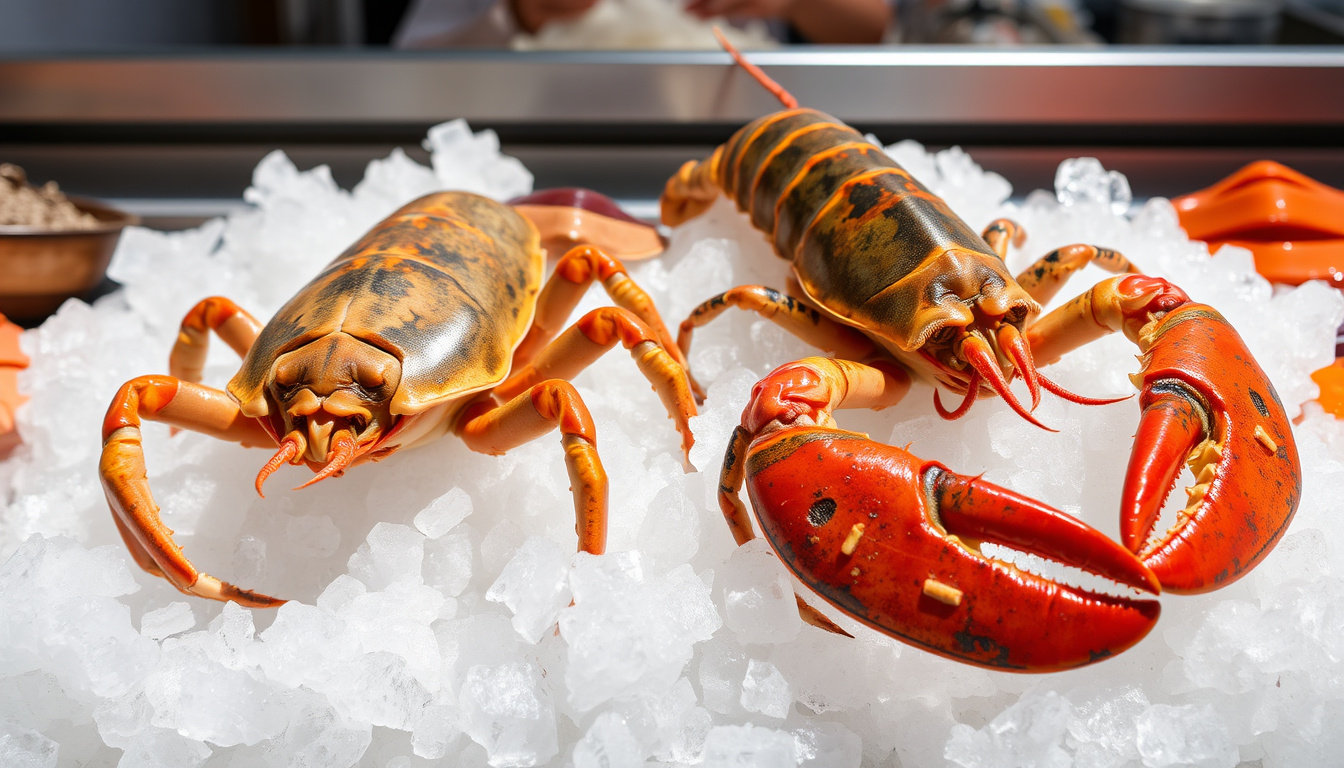
If you’ve ever spotted a flat, broad crustacean at a Sydney fish market and wondered whether it’s a lobster or something else, you’re not alone. Moreton Bay bugs (Thenus orientalis and Thenus parindicus) are slipper lobsters that have earned a loyal following among Aussie seafood lovers for their sweet, delicate meat.
Scientific name: Thenus orientalis (reef bug) and Thenus parindicus (mud bug) ·
Common names: Moreton Bay bug, Bay Lobster, Slipper lobster ·
Average weight: 200–500 g (7–18 oz) ·
Maximum depth: 100 m (330 ft) ·
Annual Australian catch: ~500 tonnes (as of 2020)
Quick snapshot
- Also known as Bay Lobster or Slipper Lobster (Gourmet Traveller (Australian food magazine))
- Family Scyllaridae, not true lobsters (Wikipedia (community encyclopedia))
- Two species: Reef Bug and Mud Bug (Australian Bay Lobster Producers (land‑based aquaculture company))
- Common in Australian seafood markets (GoodFish Australia Sustainable Seafood Guide (seafood sustainability NGO))
- Soft muddy or sandy bottoms (Gourmet Traveller)
- Depth up to 100 metres (Gourmet Traveller)
- Found in northern Australia, also in SE Asia (Wikipedia)
- Warm tropical waters (Australian Bay Lobster Producers)
- Sweet, delicate meat, similar to lobster or prawn (Gourmet Traveller)
- Firm texture, white flesh (Gourmet Traveller)
- Best grilled, barbecued, or steamed (Gourmet Traveller)
- Popular with garlic butter or herbs (Gourmet Traveller)
- Wild‑caught, rated “Eat Less” by GoodFish (GoodFish Australia)
- Managed under Australian fisheries (GoodFish Australia)
- Available fresh or frozen at seafood markets (Australian Bay Lobster Producers)
- Price moderate, often cheaper than lobster (Gourmet Traveller)
Eight key facts at a glance — one table that covers the essential details for anyone comparing these crustaceans.
| Attribute | Details |
|---|---|
| Scientific name | Thenus orientalis (Reef Bug) / Thenus parindicus (Mud Bug) |
| Family | Scyllaridae (slipper lobsters) |
| Common names | Moreton Bay bug, Bay lobster, Slipper lobster |
| Habitat | Muddy or sandy bottoms, up to 100 m depth |
| Distribution | Australia (QLD, NSW, NT, WA) and Indo‑Pacific |
| Average size | 200–500 g, up to 25 cm length |
| Flavor | Sweet, delicate, similar to lobster |
| Sustainability | GoodFish rates it “Eat Less”; stocks not overfished |
Are Moreton Bay bugs the same as lobster?
Biologically, no — but the confusion is understandable. Moreton Bay bugs belong to the family Scyllaridae, while true lobsters (like the American or rock lobster) are in Nephropidae (Wikipedia). They are slipper lobsters, a group that lacks the large front claws that define true lobsters.
Key differences in anatomy and taxonomy
- Moreton Bay bugs have a flat, broad carapace and no claws (Gourmet Traveller).
- True lobsters (e.g., Homarus americanus) have large chelipeds (claws).
- Slipper lobsters are more closely related to spiny lobsters than to clawed lobsters (Wikipedia).
Taste and texture similarities
- The meat is sweet and firm, often compared to lobster tail (Gourmet Traveller).
- Many chefs say the flavor is more delicate than lobster, with a cleaner finish (Gourmet Traveller).
- Marketing as “Bay Lobster” reinforces the taste comparison (Australian Bay Lobster Producers).
The implication: if you want the lobster experience without the claws, Moreton Bay bugs deliver the same sweet flesh in a more affordable, sustainable package.
Are Moreton Bay bugs only in Australia?
While the name “Moreton Bay” ties them tightly to Queensland, the genus Thenus has a wider range. The two main species — the reef bug and the mud bug — are harvested from tropical and subtropical waters across the Indo‑Pacific.
Distribution along the Australian coast
- Primary Australian range: Queensland, New South Wales, Northern Territory, and Western Australia (Wikipedia).
- Most commercial catch comes from Queensland waters (GoodFish Australia).
Global range of Thenus species
- Thenus orientalis is recorded from eastern Africa to Japan and Australia (Wikipedia).
- Small‑scale fisheries exist in Malaysia and Singapore (Wikipedia).
- The species is also known as flathead lobster outside Australia (Wikipedia).
The catch: Australian consumers can be confident that “Moreton Bay bug” usually means local, wild‑caught product, but similar species appear on Asian seafood counters under different names.
Why is it called a Moreton Bay bug?
The name has two parts — one geographic, one descriptive. “Moreton Bay” references the bay in Queensland where the species was first documented.
Origin of the name ‘Moreton Bay’
- First described from specimens caught in Moreton Bay, near Brisbane (Wikipedia).
- Captain Cook named Moreton Bay in 1770, and the crustacean followed later.
Why ‘bug’ instead of ‘lobster’
- The flat, oval body and short antennae give it a bug‑like appearance (Gourmet Traveller).
- “Bug” is an informal Australian term for several slipper‑lobster species.
- Marketers sometimes prefer “Bay Lobster” because it sounds more familiar to tourists (Australian Bay Lobster Producers).
The trade-off: the casual name may sound unappetising to newcomers, but it captures the creature’s unique appearance — and once you taste it, the “bug” label becomes a charming quirk.
The naming confusion means consumers may overlook a sustainable, affordable alternative to lobster simply because of a label. Knowing that “bug” equals slipper lobster opens up a whole new seafood category.
What is the flavour of Moreton Bay bugs?
If you love lobster but not the price tag, Moreton Bay bugs are your answer. The meat is sweet, firm, and surprisingly consistent — a trait that professional kitchens prize.
Flavor profile compared to lobster and prawn
- Described as a cross between lobster and prawn — sweet but lighter (Gourmet Traveller).
- More consistent in flavour than many other crustaceans (Gourmet Traveller).
- White flesh turns opaque when cooked; texture is firm but not chewy.
Best cooking methods to enhance taste
- Grilling or barbecuing with garlic butter is the classic approach (Gourmet Traveller).
- Steaming preserves the delicate sweetness.
- Pair with white wine, lemon, or herb‑based sauces.
For home cooks, the bug’s flat shape makes it quick to cook and easy to shell — no cracking required.
Where are Moreton Bay bugs found?
Habitat preferences explain the two commercial species: the reef bug (Thenus orientalis) and the mud bug (Thenus parindicus).
Preferred habitat: muddy and sandy bottoms
- Both species live on soft substrates — mud, sand, or silty areas (Gourmet Traveller).
- Reef bugs associate with coral rubble; mud bugs prefer deeper, softer bottoms.
Depth range and Australian regions
- Found from the intertidal zone down to 100 m depth (Gourmet Traveller).
- Commercial trawling targets depths of 20–60 m off Queensland and NSW.
- Western Australian stocks are smaller but still fished.
The pattern: if you want the freshest bugs, buy from coastal Queensland markets — the proximity to the fishery means better quality and lower transport emissions.
Four attributes, one comparison: how the bug stacks up against the classic rock lobster.
| Aspect | Moreton Bay bug | Southern Rock Lobster |
|---|---|---|
| Family | Scyllaridae (slipper lobster) | Palinuridae (spiny lobster) |
| Claws | None | None (spiny, no large claws) |
| Average meat yield | ~25–30% of body weight | ~30–35% of body weight |
| Flavor intensity | Delicate, sweet | Rich, slightly briny |
| Sustainability rating (GoodFish) | Eat Less | Eat Less |
| Price per kg (approx.) | $25–40 AUD | $50–80 AUD |
Seven specifications that define the creature — from size to sensory traits.
| Spec | Value |
|---|---|
| Body length (max) | 25 cm |
| Weight range | 200–500 g |
| Carapace width | 8–12 cm |
| Antennae | Short, flattened (not whip‑like) |
| Color (raw) | Reddish‑brown with pale spots |
| Color (cooked) | Bright orange‑red |
| Number of legs | 10 (5 pairs) |
| Sexual maturity | ~1 year |
| Lifespan | 4–6 years |
| Preferred water temp | 22–30 °C |
Upsides
- Sweet, delicate meat appealing to a wide range of palates
- More affordable than traditional lobster
- Fast cooking time (3–5 minutes)
- Easier to handle — no claws to deal with
- Wild‑caught from well‑managed Australian fisheries
Downsides
- Limited availability outside Australia
- GoodFish rates it “Eat Less” (some sustainability concerns)
- Lower meat yield per animal compared to rock lobster
- Unappealing name can deter first‑time buyers
- Seasonal availability in some regions
Clarity: what we know and what remains unclear
Confirmed facts
- Moreton Bay bugs are slipper lobsters (family Scyllaridae)
- They are found in Australian waters and the Indo‑Pacific
- Named after Moreton Bay, Queensland
- Flavor is sweet and mild, similar to lobster
- Two species: reef bug and mud bug
What’s unclear
- Exact origin of the colloquial name “bug” is anecdotal
- Historical catch data before the 1990s is limited
- The precise sustainability rating for different regions may vary within the “Eat Less” category
- The nutritional profile may differ between wild-caught and aquaculture
- The full extent of the species’ range in the Indo-Pacific is not fully mapped
What the experts say
Moreton Bay bugs live in muddy or sandy bottoms up to a depth of 100 m.
— Queensland Government Bug Guide
Available wild‑caught, it is a marine crustacean with a reddish‑brown shell…
— Sydney Fish Market
Reef Bug and Mud Bug are sustainable species distributed along the tropical and subtropical coast of Australia.
— fish.gov.au 2020 report
For Australian diners, the choice between Moreton Bay bugs and lobster is no longer just about taste — it’s about budget and sustainability. If you’re after the classic lobster experience without the premium price, the bug delivers. For those who prioritise absolute sustainability, look for bugs labelled as “Eat Less” and treat them as an occasional indulgence rather than a weekly staple.
Frequently asked questions
How do you clean Moreton Bay bugs?
Rinse under cold water, then twist off the head. Peel away the carapace and remove the digestive tract (the dark vein). The tail meat is ready to cook.
Can you freeze Moreton Bay bugs?
Yes — freeze raw or cooked in an airtight container for up to 3 months. Thaw in the fridge overnight.
Are Moreton Bay bugs high in cholesterol?
Like most crustaceans, they contain cholesterol — about 95 mg per 100 g. They are low in saturated fat, so moderate consumption is fine for most diets.
What is the best way to cook Moreton Bay bugs?
Grilling or barbecuing with garlic butter is the most popular method. Steaming works well for a lighter result, and they can also be added to pastas or salads.
Are Moreton Bay bugs expensive?
They are moderately priced — typically $25–40 AUD per kilogram, which is cheaper than rock lobster ($50–80 AUD).
How many calories in Moreton Bay bugs?
About 90–100 calories per 100 g of cooked meat, with 18–20 g of protein.
Can you eat Moreton Bay bugs raw?
Yes, if they are very fresh and properly handled — similar to lobster sashimi. Most people prefer them cooked for safety and texture.
What wine pairs with Moreton Bay bugs?
A crisp, unoaked Chardonnay, Sauvignon Blanc, or a dry Riesling complements the sweet, delicate meat.
Related reading: JW Marriott Gold Coast buffet packages · Meat and Wine Co Adelaide

Jack Hayes is Senior Reporter at Oz Monitorly, covering breaking stories and explainers.