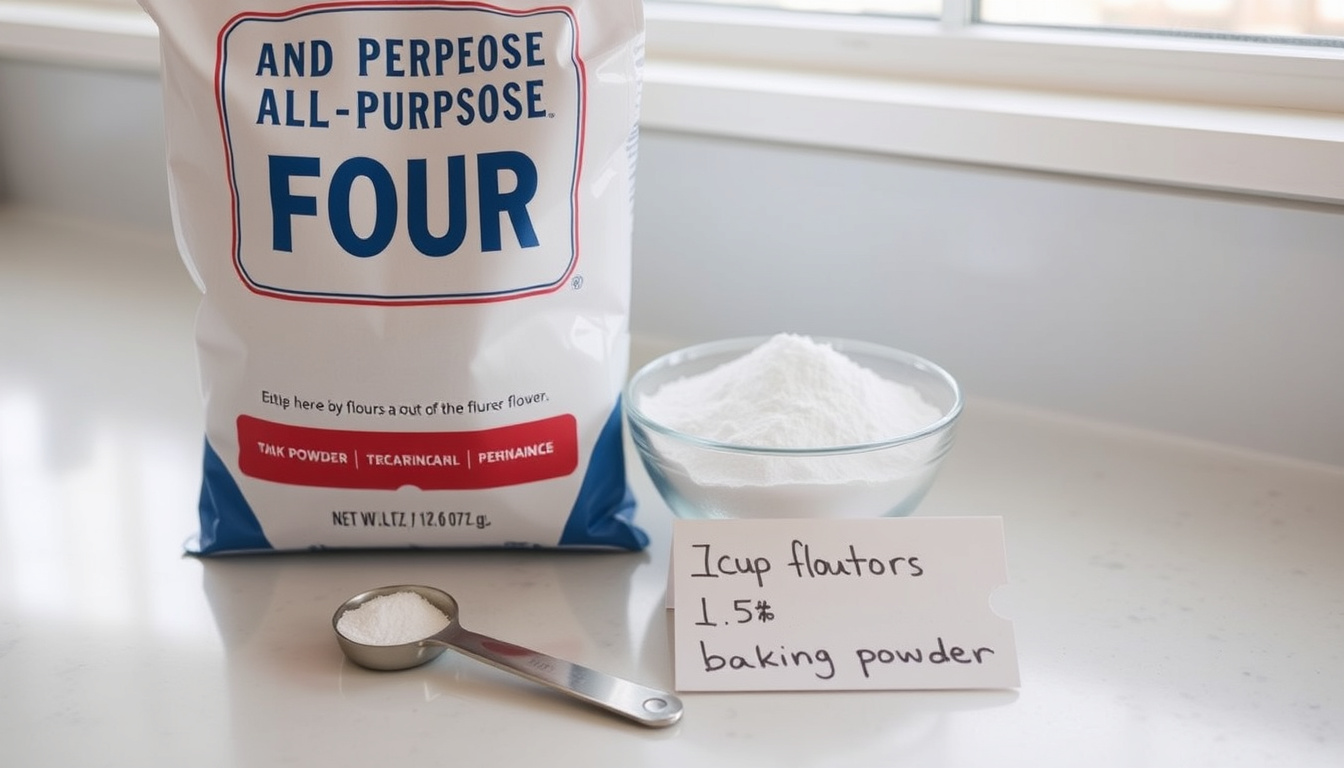
Anyone who’s ever reached for a bag of self-raising flour only to find an empty shelf knows the frustration. The solution is surprisingly simple—two ingredients you probably already have—and here are the exact ratios, so you’ll never be stuck without it again.
Plain flour required: 1 cup (150g) · Baking powder per 150g: 2 teaspoons (10g) · Salt optional per 150g: 1/4 teaspoon · Typical yield: 150g self-raising flour · Shelf life: Use within 3 months
Quick snapshot
- 100g plain flour + 1 tsp baking powder BBC Good Food (UK’s trusted recipe site)
- 150g plain flour + 2 tsp baking powder Nigella Lawson (celebrity chef)
- 1 cup (150g) + 1.5 tsp baking powder Allrecipes (user-curated recipe platform)
- 100g flour + 1 tsp baking powder (BBC Good Food ratio)
- 200g flour + 2 tsp baking powder (BBC Good Food ratio)
- 250g flour + 2.5 tsp baking powder (BBC Good Food ratio)
- 500g flour + 5 tsp baking powder (BBC Good Food ratio)
- 1 cup all-purpose flour (Allrecipes)
- 1.5 tsp baking powder (Allrecipes)
- 0.5 tsp salt Allrecipes
- 1/2 tsp baking soda per 150g flour (Weekend Bakery (home baking resource))
- 1 tsp cream of tartar per 150g flour (Weekend Bakery (home baking resource))
- Mix and use immediately Weekend Bakery (home baking resource)
Five key ratios, one pattern: the baking powder scales linearly with flour weight, but the exact amount varies by source and region.
| Label | Value |
|---|---|
| Basic substitution ratio | 1 tsp baking powder per 50g plain flour |
| BBC Good Food ratio | 100g flour + 1 tsp baking powder (BBC Good Food) |
| Nigella Lawson ratio | 150g flour + 2 tsp baking powder (Nigella Lawson) |
| Allrecipes US ratio | 1 cup flour + 1.5 tsp baking powder + 0.5 tsp salt (Allrecipes) |
| 200g in cups | Approximately 1.5 cups |
| Shelf life | 3 months in airtight container |
How can I make plain flour into self-raising?
The basic ratio: plain flour and baking powder
The core principle is straightforward: self-raising flour is just plain flour plus a leavening agent. The standard ratio used by BBC Good Food is 1 teaspoon of baking powder for every 100 grams of plain flour. Nigella Lawson uses a slightly denser ratio: 2 teaspoons per 150 grams (6 ounces). Both work; the difference matters most in delicately risen cakes.
- 100g plain flour + 1 tsp baking powder → 100g self-raising flour (BBC Good Food)
- 150g plain flour + 2 tsp baking powder → 150g self-raising flour (Nigella Lawson)
- 1 cup (150g) + 1.5 tsp baking powder + ½ tsp salt → US self-rising flour (Allrecipes)
Step-by-step mixing instructions
- Measure the required amount of plain flour into a bowl.
- Add the appropriate amount of baking powder.
- Use the spoon-and-sweep method if measuring by volume: spoon flour into the cup, then level with a knife. Do not tap or shake the cup. (Top With Cinnamon (baking blog))
- Whisk or sift the mixture together until the baking powder is evenly distributed.
Why sifting is important
Sifting aerates the flour and breaks up any lumps of baking powder, ensuring uniform leavening. Charlotte’s Lively Kitchen (baking science site) notes that even a few unincorporated pockets can cause uneven rising. A simple fine-mesh strainer over a bowl does the job in seconds.
“To make self-raising flour, mix 100g plain flour with 1 tsp baking powder.”
— BBC Good Food glossary
The 1 tsp per 100g ratio gives a slightly lighter rise than 2 tsp per 150g. For cupcakes and sponges, the lighter ratio is preferred; for scones, the denser Nigella ratio yields a sturdier crumb.
Experimenting with both ratios is the best way to find your preference.
How do I make 200g self-raising flour?
Converting 200g plain flour to self-raising
Scaling the BBC ratio, 200g of plain flour needs 2 teaspoons of baking powder. Top With Cinnamon confirms this: “For 200g plain flour, use 4 tsp baking powder” (based on 1 tsp per 50g). But note that different sources use different baselines—Nigella’s ratio would call for about 2.7 tsp for 200g. Stick with one system.
Measuring baking powder for 200g flour
- BBC method: 200g flour + 2 tsp baking powder
- Nigella method: 200g flour ≈ 2.7 tsp baking powder
- Allrecipes (US volume): 1.5 cups flour + 2.25 tsp baking powder + 0.75 tsp salt
For precision, King Arthur Baking (established baking resource) recommends weighing flour rather than using cup measures, as a cup of flour can vary from 120g to 150g depending on how it’s scooped.
Variations for US cups
200g of self-raising flour equals approximately 1.5 US cups (Charlotte’s Lively Kitchen gives 1 metric cup = 250ml, holding about 167g). If using cups, spoon the flour in and level off.
Accuracy in measuring is crucial for consistent results.
What can I use if I don’t have self-raising flour?
Baking powder as the substitute
Self-raising flour is plain flour plus baking powder (and sometimes salt). The most direct substitute is to add leavening yourself. Allrecipes suggests 1.5 teaspoons baking powder and 0.5 teaspoon salt per cup (150g) of all-purpose flour. This replicates the commercial US self-rising flour formula.
Using baking soda and buttermilk
If you’re out of baking powder, you can use baking soda plus an acid. Weekend Bakery provides a DIY baking powder blend: ½ teaspoon cream of tartar, ¼ teaspoon baking soda, and ¼ teaspoon cornstarch replaces 1 teaspoon of commercial baking powder. For each 150g flour, add this blend and mix immediately—the reaction begins as soon as liquid touches the soda.
Store-bought alternatives
Some supermarkets sell self-raising flour pre-mixed with salt. King Arthur Baking notes that Southern US recipes especially rely on self-rising flour (their version adds salt). If you don’t bake often, making your own in small batches is more economical.
“Ingredients: 1 cup all-purpose flour, 1.5 teaspoons baking powder, 0.5 teaspoon salt.”
— Allrecipes self-rising flour recipe
Homemade self-raising flour lacks the anti-caking agents found in commercial versions. It must be stored in an airtight container and used within three months, or the baking powder may lose potency.
Having a backup plan for missing ingredients prevents disappointment.
How do I make self raising flour 500g?
Scaling the recipe to 500g flour
For a 500g batch, the math is straightforward. Using the 1 tsp per 50g baseline, you need 10 teaspoons (about 40g) of baking powder. BBC Good Food would call the same. Weekend Bakery notes their rule of thumb—1g baking powder per 25g flour—gives about 20g for 500g, which is less than 10 tsp (since 10 tsp ≈ 40g). The discrepancy shows why it’s wise to test which ratio works for your recipe.
Baking powder calculation for large batches
- BBC ratio: 500g flour + 5 tsp baking powder
- Nigella ratio: 500g flour + 6.7 tsp (≈ 27g) baking powder
- Weekend Bakery ratio: 500g flour + 20g (5 tsp) baking powder
- Allrecipes by volume: ~3.3 cups flour + 5 tsp baking powder + 1.7 tsp salt
Top With Cinnamon suggests that for bulk batches, you should write the date and ratio on the container so you don’t forget later.
Storage tips for bulk batches
Keep the flour in an airtight container in a cool, dark cupboard. Charlotte’s Lively Kitchen confirms that homemade self-raising flour lasts up to 3 months before the baking powder starts to degrade. To test if your blend is still active, drop half a teaspoon of the flour mixture into a small bowl of white vinegar—it should fizz vigorously.
Bulk preparation saves time but requires proper storage.
How do I make self-raising flour without baking powder?
Using baking soda and an acid
Baking soda (sodium bicarbonate) requires an acid to produce carbon dioxide. For each 150g of plain flour, use ½ teaspoon baking soda and 1 teaspoon cream of tartar (tartaric acid). Weekend Bakery describes this as a fast-acting combination—the reaction starts the moment wet ingredients are added, so the batter must go into the oven immediately.
Substitutions with cream of tartar
If you don’t have cream of tartar, you can substitute lemon juice or buttermilk as the acid. For 150g flour, add 2 tablespoons buttermilk or 1 tablespoon lemon juice along with the ½ teaspoon baking soda. Reduce any other liquid in the recipe by the same amount to maintain consistency.
When to avoid homemade self-raising flour
King Arthur Baking notes that recipes requiring long resting times—like some yeast breads or overnight pancakes—are not suitable for homemade self-raising flour because the leavening starts acting too early. Stick with commercial self-raising flour for those applications.
“Just add 2 teaspoons of baking powder for each 150g/6oz/1 cup plain flour.”
— Nigella Lawson (Nigella.com)
The speed of reaction is a critical factor to consider.
Confirmed facts
- Self-raising flour = plain flour + baking powder. (BBC Good Food)
- 1 tsp baking powder per 50g plain flour is a standard ratio. (BBC Good Food)
- Sifting ensures even distribution of baking powder. (Top With Cinnamon)
- Homemade self-raising flour should be used within 3 months. (Charlotte’s Lively Kitchen)
What’s unclear
- Precise amount of salt may vary by recipe preference.
- Whether to use cream of tartar or lemon juice as acid when substituting baking soda.
- The exact ratio of baking powder to flour may vary by region and recipe type.
- Whether salt should be added to self-raising flour depends on the recipe tradition.
If you run out of self-raising flour, you can make your own at home using simple ratios for self-raising flour with just plain flour and baking powder.
Frequently asked questions
Can I use self-raising flour instead of plain flour?
Yes, but you must omit or reduce the baking powder and salt in the recipe. Self-raising flour contains leavening, so using it in a plain flour recipe will cause over-rising and a metallic taste from excess baking powder.
Does self-raising flour expire?
Yes. Homemade self-raising flour keeps for about 3 months in an airtight container. Store-bought versions last up to 6–9 months but lose potency over time. Test by mixing a teaspoon with vinegar—if it fizzes, it’s active.
What is the difference between self-raising flour and self-rising flour?
Spelling aside, self-rising flour (US) typically includes salt, while self-raising flour (UK) often does not. Both are plain flour with added baking powder. Check the label if you need salt-free for a specific recipe.
Can I make self-raising flour with baking soda instead of baking powder?
Yes, but you must add an acid such as cream of tartar, buttermilk, or lemon juice. Without the acid, baking soda alone will leave a soapy flavour and won’t provide enough lift.
How much baking powder do I add to 200g plain flour?
Using the standard 1 tsp per 50g ratio, add 4 tsp of baking powder. For a lighter rise (BBC ratio), use 2 tsp. Always sift to distribute evenly.
Is self-raising flour the same as all-purpose flour?
No. All-purpose flour (US) is plain flour with no leavening added. Self-raising flour has baking powder already mixed in. All-purpose flour can be turned into self-raising flour by adding baking powder (and optionally salt).
Can I use self-raising flour for yeast bread?
Not ideally. Yeast breads rely on gluten development and long fermentation; the baking powder in self-raising flour will start reacting early, leading to a dense or off-flavour loaf. Stick with bread flour for yeast breads.
For the home baker who bakes a few times a month, keeping a jar of homemade self-raising flour on hand is both cost-effective and space-saving. The trade-off is clear: measure precisely, sift carefully, and use it within three months—or risk a sunken sponge.

Jack Hayes is Senior Reporter at Oz Monitorly, covering breaking stories and explainers.